The
Campbell-Railton Blue Bird was Sir Malcolm Campbell's final land speed record
car.
His
previous Campbell-Napier-Railton Blue Bird of 1931 was rebuilt significantly.
The overall layout and the simple twin deep chassis rails remained, but little
else. The bodywork remained similar, with the narrow body, the tombstone radiator
grille and the semi-spatted wheels, but the mechanics were new.
Most
significantly, a larger, heavier and considerably more powerful Rolls-Royce R
V12 engine replaced the old Napier Lion, again with supercharger. This required
two prominent "knuckles" atop the bodywork, to cover the V12 engine's
camboxes.
Blue Bird's
first run was back at Daytona, setting a record of 272 miles per hour (438
km/h) on 22 February 1933.
Campbell
now had a car with all the power that he could want, but no way to use all of it.
Wheelspin was a problem, losing perhaps 50 miles per hour (80 km/h) from the
top speed.
Mechanically
the changes to the car had focussed on improving the traction, rather than
increasing the already generous power. Double wheels and tyres were fitted to
the rear axle, to improve grip. The final drive was also split into separate
drives to each side.
This reduced the load on each drive, allowed the driver
position to be lowered, but required the wheelbase to be shortened
asymmetrically on one side by 1½"(37 mm). Airbrakes were fitted, actuated
by a large air cylinder. For extra streamlining the radiator air intake could
be closed by a movable flap, for a brief period during the record itself.
Visually the car was quite different.
The bodywork was now rectangular in cross
section and spanned the full width over the wheels. Although actually higher,
this increased width gave the impression of a much lower and sleeker car,
accentuated by the long stabilising tailfin and the purposeful raised ridges
over the engine camboxes.
This Blue Bird was clearly a design of the Modernist
'30s, not the brute heroism of the '20s. Blue Bird made its first record runs
back on Daytona Beach in early 1935. On 7 March 1935 Campbell improved his
record to 276.82 mph (445.5 kph), but the unevenness of the sand caused a loss
of grip and he knew the car was capable of more. The faster car needed a bigger
and smoother arena, and this led to the Bonneville Salt Flats of Utah. This
time the young Donald Campbell accompanied his father. On 3 September 1935, the
300 mph barrier fell by a bare mile-per-hour, crowning Sir Malcolm Campbell's
record-breaking career. Blue Bird's first run was back at Daytona, setting a
record of 272 miles per hour (438 km/h) on 22 February 1933. Campbell now had a
car with all the power that he could want, but no way to use all of it.
Wheelspin was a problem, losing perhaps 50 miles per hour (80 km/h) from the
top speed. Visually the car was quite different. The bodywork was now
rectangular in cross section and spanned the full width over the wheels.
Although actually higher, this increased width gave the impression of a much
lower and sleeker car, accentuated by the long stabilising tailfin and the
purposeful raised ridges over the engine camboxes. This Blue Bird was clearly a
design of the Modernist '30s, not the brute heroism of the '20s. Mechanically
the changes to the car had focussed on improving the traction, rather than
increasing the already generous power. Double wheels and tyres were fitted to
the rear axle, to improve grip. The final drive was also split into separate
drives to each side. This reduced the load on each drive, allowed the driver
position to be lowered, but required the wheelbase to be shortened
asymmetrically on one side by 1½"(37 mm). Airbrakes were fitted, actuated
by a large air cylinder. For extra streamlining the radiator air intake could
be closed by a movable flap, for a brief period during the record itself. Blue
Bird made its first record runs back on Daytona Beach in early 1935. On 7 March
1935 Campbell improved his record to 276.82 mph (445.5 kph), but the unevenness
of the sand caused a loss of grip and he knew the car was capable of more. The
faster car needed a bigger and smoother arena, and this led to the Bonneville
Salt Flats of Utah. This time the young Donald Campbell accompanied his father.
On 3 September 1935, the 300 mph barrier fell by a bare mile-per-hour, crowning
Sir Malcolm Campbell's record-breaking career.
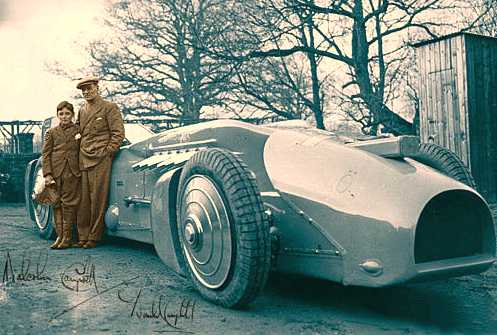
[Blue Bird
1933]
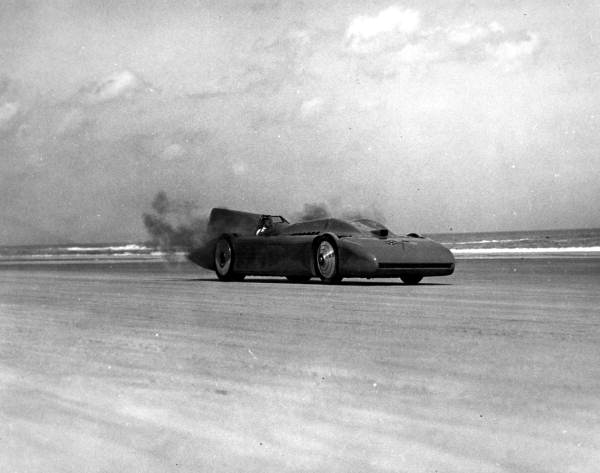
[Blue Bird 1935]

[ Bluebird 1964 ]


[ Electric Bluebird ]