Friday, June 8, 2012

Diabolik Jaguar's - E-Type (XK-E)


The Jaguar "E" type (also known as E-type or XK-E) is one of the greatest cars ever built.
It has style, performance, and pedigree: its shell was designed by an aerodynamics engineer, it was propelled by a high-spec version of the famous XK engine, and was based on the 50's Le Mans winning D type race car.
Best of all, unlike other 'supercars' of its time, it was a mass-market product: over 70.000 have been built.


Thursday, June 7, 2012

Michal Schumacher's Bike.


Several of Schumacher friends had conspired to present him with a going-away gift that didn't require a ribbon. Knowing that Schumacher was also a big bike fan, having several in his garage back home in Switzerland, they came up with a plan thanks to a Ferrari owner in the Los Angeles area who suggested, "Hey, why not build him a one-off, very cool, custom bobber?" And, of course, paint it Ferrari red. He knew just the place: the Garage Company, home of vintage and classic bikes as well as the shop's unique line of retro-bobbers.

Dubbed the "MS Bobber" (a.k.a. Speed Boy Special), the bike seen here was built from the ground up in just 22 days after Yoshi, the Garage Company's honcho, got the word about the project.

Based on a 1981 80-inch Shovelhead, the hot-rodded engine features S&S rods, KB pistons, Rowe valves, a Sifton cam and Crane Lifters, all fed from a classic "peanut" gas tank via an S&S E carb and treated to what the Garage Co. calls a "natural finish." Details include a vintage H-D six-inch air cleaner for easy breathing. The Shovel shifts gears through a matching 1981 H-D four-speed gearbox benefiting from a Primo clutch/primary drive combo while the whole drivetrain is embedded in a 1981 H-D hardtail frame with a 33-degree rake.


Matching engine, tranny and frame keeps the nostalgia factor at full throttle, as does the Springer front-end teamed with a set of vintage triple trees.

It's a Bobber, so 16-inch doughnuts are a must front and rear, and classic Firestones at that. Drum brakes are there if you feel like slowing down.

In the fit-and-finish department, the bike wasn't just painted Ferrari red in commemoration of Schumacher's 10 years with the manufacturer, but specifically 2006 factory Ferrari F1 red. Jim's Cycle Painting sprayed it on with special graphics created by Bob Iverson. While the Bobber is a non-chromer, it does sport some nickel-plated goodies courtesy of Supreme Plating.

They say greatness is in the details, and the MS Bobber has a list of them including: oil tank and hand controls from Tedd Cycle; Autometer gauge; CCI headlight; solo seat by Back Drop USA; and the Garage Company's own take on handlebars, license mount and LED taillight.


Kimi Raikkonen's Bike - 120hp and 100.000 Euro

Sure, you may think that racing Formula 1 in the Championship-winning Ferrari is pretty hardcore, but Kimi Räikkönen has an even better idea of what being hardcore really means. Or not. Whatever... what we do know is that Marcus Walz of Hardcore Cycles has made Räikkönen another bike. The first one was known as "Iceman", and the second has been imaginatively named "Iceman 2". The machine itself is pretty cool, although the basic premise of the machine is decidedly low-tech. Sure, it's got a single-sided swingarm, but no rear suspension to speak of. The fork may be high-tech, but it's placed at such an angle as to undermine its operation.

All of the preceding is beside the point, however. This bike is not meant to out-handle a Supermoto or out-race a GSXR. It's meant to be as much about style as function, and the rider is expected to show it off whenever possible. Good thing the bike looks so good, then. And when Kimi wants to go fast... that's not so much of a problem either.


Wednesday, June 6, 2012

The Blue Bird - Born to be fast (since 1933)


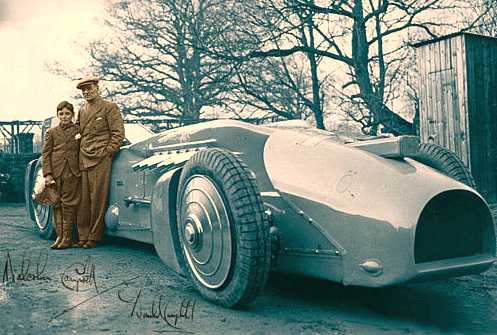
The Campbell-Railton Blue Bird was Sir Malcolm Campbell's final land speed record car.

His previous Campbell-Napier-Railton Blue Bird of 1931 was rebuilt significantly. The overall layout and the simple twin deep chassis rails remained, but little else. The bodywork remained similar, with the narrow body, the tombstone radiator grille and the semi-spatted wheels, but the mechanics were new.

 Most significantly, a larger, heavier and considerably more powerful Rolls-Royce R V12 engine replaced the old Napier Lion, again with supercharger. This required two prominent "knuckles" atop the bodywork, to cover the V12 engine's camboxes.
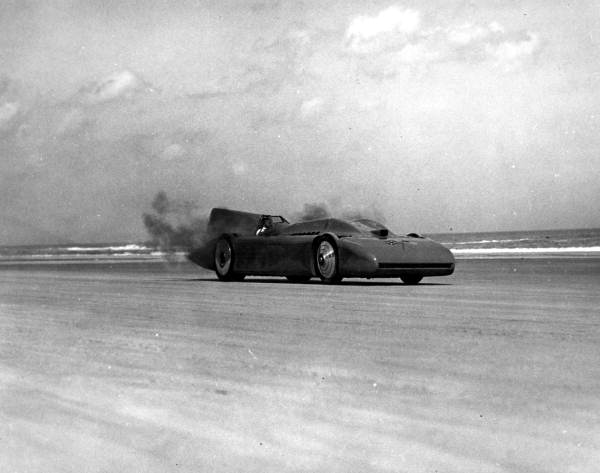
Blue Bird's first run was back at Daytona, setting a record of 272 miles per hour (438 km/h) on 22 February 1933.
Campbell now had a car with all the power that he could want, but no way to use all of it. Wheelspin was a problem, losing perhaps 50 miles per hour (80 km/h) from the top speed.
Mechanically the changes to the car had focussed on improving the traction, rather than increasing the already generous power. Double wheels and tyres were fitted to the rear axle, to improve grip. The final drive was also split into separate drives to each side. 

This reduced the load on each drive, allowed the driver position to be lowered, but required the wheelbase to be shortened asymmetrically on one side by 1½"(37 mm). Airbrakes were fitted, actuated by a large air cylinder. For extra streamlining the radiator air intake could be closed by a movable flap, for a brief period during the record itself. Visually the car was quite different. 

The bodywork was now rectangular in cross section and spanned the full width over the wheels. Although actually higher, this increased width gave the impression of a much lower and sleeker car, accentuated by the long stabilising tailfin and the purposeful raised ridges over the engine camboxes. 

This Blue Bird was clearly a design of the Modernist '30s, not the brute heroism of the '20s. Blue Bird made its first record runs back on Daytona Beach in early 1935. On 7 March 1935 Campbell improved his record to 276.82 mph (445.5 kph), but the unevenness of the sand caused a loss of grip and he knew the car was capable of more. The faster car needed a bigger and smoother arena, and this led to the Bonneville Salt Flats of Utah. This time the young Donald Campbell accompanied his father. On 3 September 1935, the 300 mph barrier fell by a bare mile-per-hour, crowning Sir Malcolm Campbell's record-breaking career. Blue Bird's first run was back at Daytona, setting a record of 272 miles per hour (438 km/h) on 22 February 1933. Campbell now had a car with all the power that he could want, but no way to use all of it. Wheelspin was a problem, losing perhaps 50 miles per hour (80 km/h) from the top speed. Visually the car was quite different. The bodywork was now rectangular in cross section and spanned the full width over the wheels. Although actually higher, this increased width gave the impression of a much lower and sleeker car, accentuated by the long stabilising tailfin and the purposeful raised ridges over the engine camboxes. This Blue Bird was clearly a design of the Modernist '30s, not the brute heroism of the '20s. Mechanically the changes to the car had focussed on improving the traction, rather than increasing the already generous power. Double wheels and tyres were fitted to the rear axle, to improve grip. The final drive was also split into separate drives to each side. This reduced the load on each drive, allowed the driver position to be lowered, but required the wheelbase to be shortened asymmetrically on one side by 1½"(37 mm). Airbrakes were fitted, actuated by a large air cylinder. For extra streamlining the radiator air intake could be closed by a movable flap, for a brief period during the record itself. Blue Bird made its first record runs back on Daytona Beach in early 1935. On 7 March 1935 Campbell improved his record to 276.82 mph (445.5 kph), but the unevenness of the sand caused a loss of grip and he knew the car was capable of more. The faster car needed a bigger and smoother arena, and this led to the Bonneville Salt Flats of Utah. This time the young Donald Campbell accompanied his father. On 3 September 1935, the 300 mph barrier fell by a bare mile-per-hour, crowning Sir Malcolm Campbell's record-breaking career.


[Blue Bird 1933]


[Blue Bird 1935]

[ Bluebird 1964 ]


[ Electric Bluebird ]

Salt Lake Bonneville - History and Stats


Bonneville Speedway is an area of the Bonneville Salt Flats near Wendover, Utah, that is marked out for motor sports. It is particularly noted as the venue for numerous land speed records.
The salt flats were first used for motor sports in 1912, but didn't become truly popular until the 1930s when Ab Jenkins and Sir Malcolm Campbell competed to set land speed records.


Speed Record


1935


Sir Malcolm Campbell


Blue Bird
MPH


301.129
KM/H


484.620

1947Don WaiteThe Edelbrock Special192309
1963Craig BreedloveSpirit of America407.447655.722
1963Dick BeithPepco VW Type 1 ("Beetle")129.65208.651

1964Art ArfonsThe Green Monster434.022664.694
1965Craig BreedloveSpirit of America - Sonic 1600.601966.574
1969Burt MunroIndian Scout V-Twin183.59295.44
1970Gary GabelichBlue Flame622.4071001.67
2001Don VescoVesco Turbinator - Turbine Engine458.443737.395
2004R. SchroeBuckeye Bullet - Electric Vehicle314.958524.930
2006Andy GreenJCB Dieselmax - Diesel Streamliner350.092563.418


History and Land Speed Records

This area, located within the Bonneville Salt Flats near Wendover, Utah, has been first recognized for its racing potential in 1896. In 1907 Rishel and two local businessmen tested the suitability of the salt for driving on by taking a Pierce Arrow onto the surface of the flats. A railway line across the Bonneville 

Salt Flats was completed in 1910, marking the first permanent crossing. The salt flats was first used as a speedway in 1914, when Teddy Tetzlaff drove his car to an official record speed of 141.73 mph. 

However, the salt flats proved their excellent racing qualities in the 1930's when Utah driver Ab Jenkins lured British racer Sir Malcolm Campbell to compete for speed records on the salt surface. Since then, hundreds of records have been set and broken in a variety of automotive and motorcycle classes. Speeds went to 300, 400, 500 and then even the 600 mph barrier was broken.

The 1960’s brought jet-powered cars piloted by the likes of Art Arfons, Bob Summers, Bobby Tatroe, Craig Breedlove, Don Vesco, Elwin Teague, Gary Gabelich, George E. Eyston, John Cobb, Nolan White, Sir Malcolm Campbell, Tom Burkland, Tom Green and even a rocket powered car named the "Blue Flame" somewhere in the 1970's.

In 1960, Mickey Thompson became the first American to break the 400 mph (644 km/h) barrier hitting 406.60 mph (654.36 km/h) surpassing John Cobb’s 1947 one-way Land speed record of 403 mph (649 km/h). In 1970, Gary Gabolich's rocket car, "Blue Flame", attained 622.4 mph (1001.65 km/h) 


Tuesday, June 5, 2012

Lamborbiker - Flavio Adriani's Bike.


The Lamborbiker is a concept bike from designer Flavio Adriani, who was inspired by Marcello Gandini, chief designer of Bertone and freelance designer since 1980. Gandini was also designer of the Osmos wheel and the Lamborghini Countach. While some may not equate the Lamborbiker’s skeletal frame to the Lamborghini Countach, others may still appreciate the design direction of the bike in terms of its curved lines and sleek frame. The hubless wheels are also a great addition to the bike, as it gives it more of a futuristic feel.


Italians do it better - Marcello Gandini's works on millecavalli

                                                               
    [ Marcello Gandini ]


[Lamborghini Countach ]


[ Lamborghini Miura ]

[Marcello Gandini's Sketch ]

Marcello Gandini is an Italian car designer, widely known for his work with the automotive design house Gruppo Bertone, notably his design of the Lamborghini Countach. Gandini belongs to a triumvirate, along with Giorgetto Giugiaro and Leonardo Fioravanti, of noted Italian car designers, all born in 1938, within months of each other. Gandini currently continues to work on automotive and aviation design.
In a 2009 interview with Robert Cumberford, editor at Automobile Magazine, Gandini indicated "his design interests are focused on vehicle architecture, construction, assembly, and mechanisms - not appearance.Gandini was one of twenty-five designers nominated for Car Designer of the Century

    • Alfa Romeo Montreal
    • Alfa Romeo 33 Carabo
    • BMW 5 Series (first gen)
    • Bugatti EB110
    • Citroën BX
    • Cizeta Moroder V16T
    • De Tomaso Pantera 90 Si
    • Ferrari Dino 308GT4
    • Fiat 132
    • Fiat X1/9
    • Iso Lele
    • Lamborghini Countach
    • Lamborghini Diablo
    • Lamborghini Espada
    • Lamborghini Jarama
    • Lamborghini Miura
    • Lamborghini Urraco
    • Lancia Stratos
    • Maserati Khamsin
    • Maserati Ghibli
    • Maserati Quattroporte IV (1994–2001)
    • Maserati Shamal
    • Renault 5 Supercinq
    • De Tomaso Biguà, Qvale, and Mangusta


[ Lancia Stratos ]


[ Maeserati Shamal ]


[ Lamborghini Espada ]

Chicks #12


SpeedBowl board-tracker by Fred Krugger


SpeedBowl by Fred Krugger board-track style custom
Custom frame by Krugger, 2005 RevTech "Pandemonium" 88ci (1450cc) engine, RevTech transmission, Barnett clutch, oil-in-frame, fork, wheels & all that's left, by Krugger.

www.krugger.net


Monday, June 4, 2012

"I know it, I know it!!!"

Stupid desperate housewife destroy probably the most precious thing of this man... His wonderful Shelby Cobra...!

Top ten motorcycle fails.....

And now...... bikers!!!

Best of supercar drivers idiots

These drivers have the money... and nothing else!

Saturday, June 2, 2012

Michael Schumacher's Advertising Campaign for Fiat and Mercedes. Genius!


[Mercedes SLS AMG with Michael Schumacher]


[Nico Rosberg & Michael Schumacher for Mercedes Benz]


[Michael Schumacher for Fiat]

Wonderful BMW 60's Ad - posted by millecavalli


1965 “Happy for a Lifetime” ad — engaging BMW “If you want to be happy for a lifetime, ride a BMW” ad from 1965.

Friday, June 1, 2012

Jay Leno, Jay K, Michael Schumacher - Celebrity Cars


Jay K's  (Jamiroquai) - Maserati A6G54


   Michael Schumacher's - Bugatti EB110 Supersport


Jay Leno - Maserati 250F